
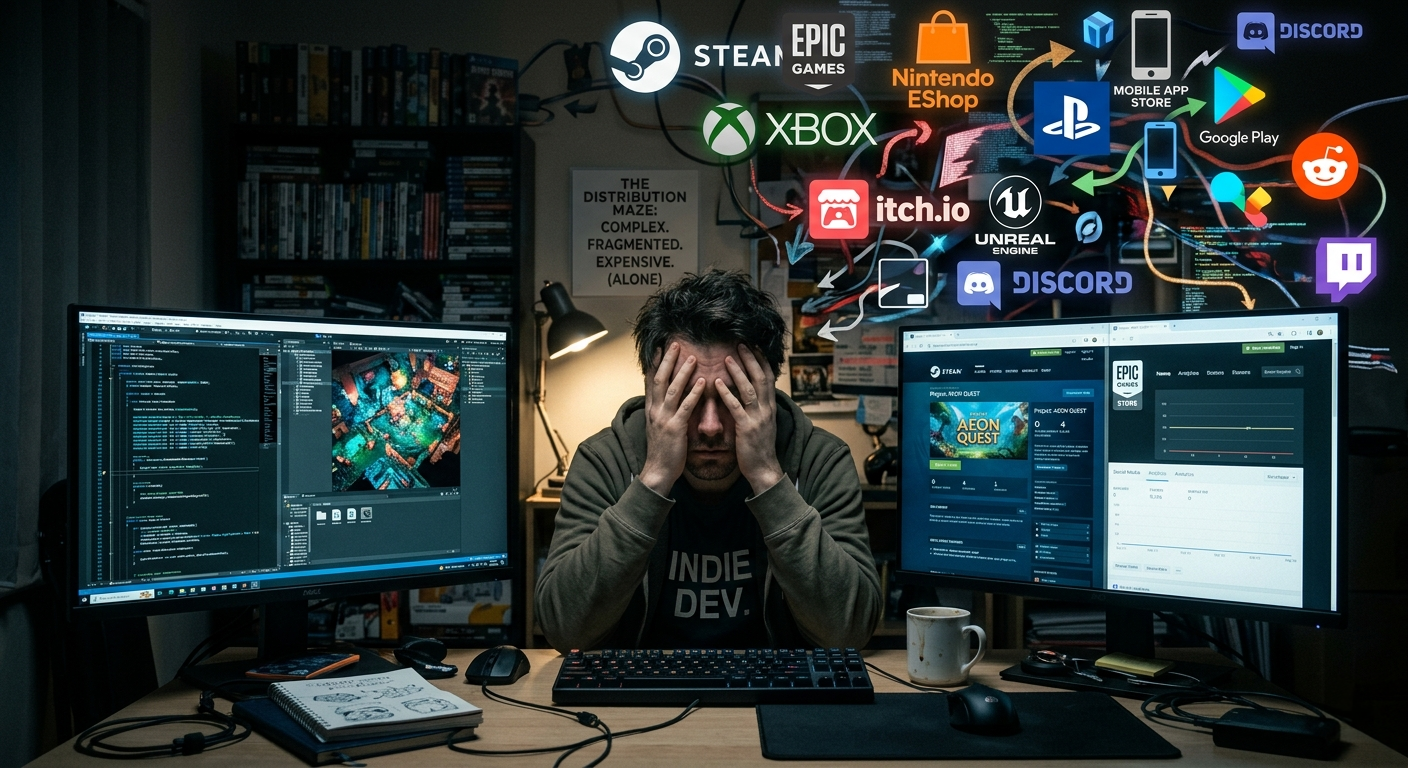
Why Great Products Die on the Launchpad
Imagine dedicating months, perhaps years, of your life to building something exceptional. You’ve written clean, scalable code, designed an intuitive user interface, and ironed out every last bug. Whether it’s an indie game with a breathtaking narrative or a SaaS tool that saves businesses ten hours a week, the product is undeniable. It is a masterpiece.
Then, you launch. And… silence.
This is the great, quiet tragedy of the modern digital ecosystem: Too many great games and software products never reach their full audience not because the product is weak, but because distribution is complex, fragmented, and expensive to navigate alone.
In the current creator economy, building a great product is no longer the finish line. It’s barely the entry ticket. The real battle isn’t fought in the IDE or the game engine; it is fought in the chaotic, crowded coliseum of distribution.
1. The Trap of the “Build It and They Will Come” Myth
For decades, tech culture has romanticized the solitary genius. We love the story of the developer who builds a tool in their garage, uploads it to the internet, and wakes up a millionaire.
But in reality, reliance on pure meritocracy is a trap.
The barrier to entry for creating software and games has plummeted. Thanks to powerful engines like Unity and Unreal, accessible frameworks, and AI-assisted development tools, more software is being built than ever before. But this democratization of creation has led to a hyper-saturation of visibility.
The Reality Check:Steam sees over 14,000 new game titles launched a year, while the Apple App Store and Google Play Store add thousands of apps daily. In the B2B software world, the average enterprise marketplace is a dense jungle of lookalikes.
When you throw your product into this ocean, it doesn’t matter if your code is flawless. If your target users don’t know you exist, your product effectively doesn’t exist.
2. The Fragmentation Matrix: Where Do You Even Sell?
Distribution used to be simple: you put your software on a disc or a website, and people downloaded it. Today, distribution is highly fragmented across competing ecosystems, each with its own rules, algorithms, and gatekeepers.
For Game Developers:
Do you launch exclusively on Steam? Do you try to get Epic Games Store backing? What about consoles, navigating the opaque certification processes of Nintendo, PlayStation, and Xbox? If you’re targeting mobile, how do you survive the shifting sand of privacy changes (like Apple’s ATT framework) that have turned mobile user acquisition upside down?
For Software/SaaS Creators:
Are you selling directly via your website? Do you list on Product Hunt and pray for a viral launch? Do you embed yourself into the Salesforce, HubSpot, or Shopify marketplaces?
Every single one of these channels requires a completely different technical integration, a tailored marketing strategy, and an understanding of specific algorithmic ranking factors. Navigating this web alone is a full-time job that drains creative energy away from the product itself.
3. The Pay-to-Play Tax
Even if you figure out where to sell, you are instantly met with the brutal economics of modern discovery: User Acquisition (UA) is a rich man’s game.
Organic reach on social media is at an all-time low. Algorithms are engineered to favor paid promotion. To get eyeballs on your software or game, you are forced to step into the digital ad auctions, competing directly against AAA gaming studios and venture-backed SaaS giants for the same target keywords and user demographics.
- The Budget Shift: Historically, marketing might have consumed 10% to 20% of a project’s budget. Today, independent developers frequently have to allocate 30% to 50% (or more) of their total resources just to stand a chance at being discovered.
- The Storefront Cut: On top of ad spend, platform gatekeepers take a massive bite out of your revenue (the standard 15% to 30% platform fee), making it incredibly difficult for self-funded creators to reinvest and scale.
Overcoming the Distribution Void
If distribution is a broken, expensive, fragmented mess, how do independent creators survive? The answer lies in changing how we approach the entire lifecycle of a product.
- Build a Community, Not Just a Product: Do not wait until launch day to find your audience. Involve users early through open Alphas, Discord communities, and transparent build-in-public initiatives. A passionate core community of 1,000 people will act as your organic distribution engine.
- Design for Inherited Virality: Build distribution into the product. Can your SaaS tool have a collaborative feature that requires users to invite their colleagues? Does your game have built-in mechanics that make it highly “streamable” on Twitch or clip-able on TikTok?
- Look for Strategic Alliances: Navigating distribution alone is a fast track to burnout. Independent developers are increasingly turning to co-publishing collectives, boutique agencies, or platform partnerships that take on the burden of marketing and distribution in exchange for revenue shares.
The Bottom Line
A weak product with brilliant distribution can easily find short-term commercial success. But a brilliant product with zero distribution is doomed to be an undiscovered treasure.
As creators, we have to respect the market as much as we respect the craft. Stop treating distribution as an afterthought or a necessary evil to deal with at the finish line. Start treating it as a core component of your architecture. Your product deserves to be found, don’t let complex distribution be the reason it stays in the dark.